The modern operational headache isn’t a lack of software—it’s an overload of it. Today’s businesses are drowning in a sea of disconnected applications. Sales teams live in their CRM, accounting runs on finance software, warehouse managers rely on spreadsheets, and executives are left trying to piece together the truth from fragmented dashboards.
When data is trapped in isolated silos, businesses slow down, human errors increase, and strategic blind spots multiply.
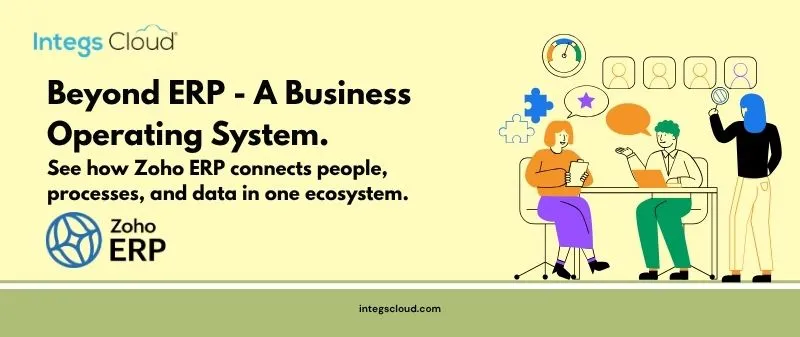
We need to stop looking at enterprise software the old way. An ERP shouldn’t just be another tool sitting on a desktop. It should function as the actual operating system of the business—the layer that quietly connects and runs everything in the background while teams focus on growth.
As a Zoho ERP partner, we help businesses design, implement, and optimize this unified operating system to ensure processes, data, and decision-making work as one connected ecosystem.
The Evolution: From Transactional Tools to Business Ecosystems
Historically, Enterprise Resource Planning (ERP) systems were glorified digital ledgers—rigid back-office software meant solely for tracking inventory, procurement, and basic accounting.
But modern commerce moves too fast for rigid software. The current market demands agility, deep integration, and instant intelligence. This shifting landscape has evolved the traditional ERP into a dynamic business ecosystem.
Traditional ERP (A tool for isolated tasks) ➔ Modern ERP OS (The central nervous system)
When you view your business infrastructure through the lens of an operating system:
- Departments become integrated applications (Sales, HR, Finance).
- Information flows continuously across boundaries without manual exports.
- Processes run autonomously in the background.
- Strategic Insights are generated instantly, removing the guesswork from leadership decisions.
Deconstructing the “Business OS” Concept
What does it actually mean to run an organization on a business operating system? Let’s map a standard computer’s architecture directly to a company’s infrastructure:
|
Computer Component |
Business Equivalent |
Zoho ERP Architecture |
|
Hardware and Resources |
Capital, Staff, Inventory, Suppliers |
Core database and asset tracking |
|
Applications |
Browsers, Word Processors, Media Players |
CRM, Finance, HR, Supply Chain tools |
|
System Workflows |
Background processes, file transfers |
Order-to-cash, hire-to-retire pipelines |
|
User Interface |
The desktop, mouse, and menus |
Live dashboards and unified portals |
Instead of forcing your staff to constantly switch contexts, log into multiple platforms, and manually bridge data gaps, Zoho ERP creates a single environment where everyone plays by the same rules and looks at the same numbers.
The Architecture of a Unified Platform
Centering your operations around Zoho ERP replaces chaotic, ad-hoc integrations with a cleanly engineered foundation. This unified approach delivers four critical structural advantages:
- A Single Source of Truth: Sales figures, invoice statuses, inventory levels, and customer profiles are housed in a single data layer. When a change happens in one corner of the business, the entire system updates instantly.
- Intertwined Workflows: Departments no longer operate in isolation. A closed deal in the sales pipeline automatically checks warehouse stock, generates a digital invoice, and alerts logistics for shipping.
- Live Operational Guardrails: Leadership teams don’t have to wait for end-of-month or end-of-quarter reviews to know how the business is performing. Live dashboards provide an accurate, real-time snapshot of the company’s health.
- Proactive Automation: High-volume, repetitive tasks—like approval routing, follow-up emails, and restocking alerts—run hands-free, freeing up your team for high-value strategic work.
Facing Modern Market Complexities
The transition toward a comprehensive business OS isn’t just a tech trend; it’s a survival strategy for a complex market. Organizations today face unprecedented hurdles:
- Volatile, multi-continental supply chains.
- Omnichannel sales structures spanning physical, digital, and partner networks.
- Rising operational overhead and narrowing profit margins.
- The absolute necessity for rapid, data-backed pivoting.
Siloed apps simply cannot keep pace with these challenges. A unified ecosystem provides the coordination, speed, and agility required to navigate modern market volatility.
The Zoho Ecosystem Advantage
Zoho redefines the operating system concept by offering a natively built, deeply intertwined suite of business applications. Instead of trying to bolt together expensive, third-party software modules with fragile APIs, Zoho provides a fluid experience out of the box:
The Connected Core: By pairing robust financial tracking with dynamic CRM pipelines, intelligent inventory management, and deeply embedded analytics, Zoho transforms separate business units into a synchronized operational engine.
Strategic Rewards: Moving from Reactive to Proactive
When you commit to an ERP ecosystem approach, the operational benefits compound quickly:
- Decisive Agility: Make critical choices based on live market and internal data, not historical guesswork.
- Frictionless Collaboration: Eliminate inter-departmental finger-pointing by giving everyone access to the same data.
- Failsafe Accuracy: Drastically reduce human errors by eliminating manual double-entry across systems.
- Elastic Scalability: Add new business lines, locations, or products to an existing infrastructure that is built to grow.
Conclusion
The true value of a modern ERP is not defined by a long list of features, but by its ability to connect the dots across the entire business.
Zoho ERP represents a fundamental shift away from disjointed, fragmented applications toward a unified business operating system. When your software functions as a true ecosystem, businesses move from managing disconnected tools to orchestrating seamless, scalable growth.
Working with a Zoho ERP partner ensures this ecosystem is designed, implemented, and aligned with business processes from the very beginning—so the system supports growth instead of creating complexity.
Ready to transform your business with Zoho ERP? Contact Integs Cloud for expert Zoho ERP implementation, customization, integration, and managed support services. Our team helps businesses build a connected, scalable ecosystem that streamlines operations, improves visibility, and accelerates growth.