As technology moves faster than ever, secure and seamless integrations are no longer optional—they’re essential. As businesses increasingly rely on real-time data exchange between systems, ensuring every connection is reliable, secure, and compliant becomes a top priority.
At Integs Cloud, we follow NetSuite-recommended best practices for all our integration architectures. One of the most critical of these practices is the adoption of OAuth 2.0 using the Client Credentials (Machine-to-Machine) Grant—a method that enables direct, secure communication between systems without manual user intervention.
Why OAuth 2.0 Matters in Modern Integrations
OAuth 2.0 is the industry standard protocol for secure authorization. It provides a flexible and safe way for applications to interact with one another while keeping sensitive data protected.
With OAuth 2.0 in place:
- Systems can exchange information without storing user credentials.
- Access can be tightly scoped—for example, limited only to certain NetSuite services like RESTlets or Web Services.
- Tokens can be auto-refreshed periodically, ensuring ongoing secure communication.
- Each integration can be audited, managed, and revoked independently, enhancing overall governance.
At Integs Cloud, we leverage OAuth 2.0 M2M to build future-proof, automated integrations between NetSuite and external systems such as ERPs, banks, and eCommerce platforms—ensuring every transaction is encrypted and authenticated.
Understanding Machine-to-Machine (M2M) Authentication
Unlike traditional OAuth flows that involve user logins or approvals, M2M authentication allows one system to securely talk to another system using a client ID and certificate key pair.
This means no human action is needed once the setup is complete—perfect for automated integrations, background processes, or scheduled data syncs between NetSuite and other platforms.
How It Works — Simplified
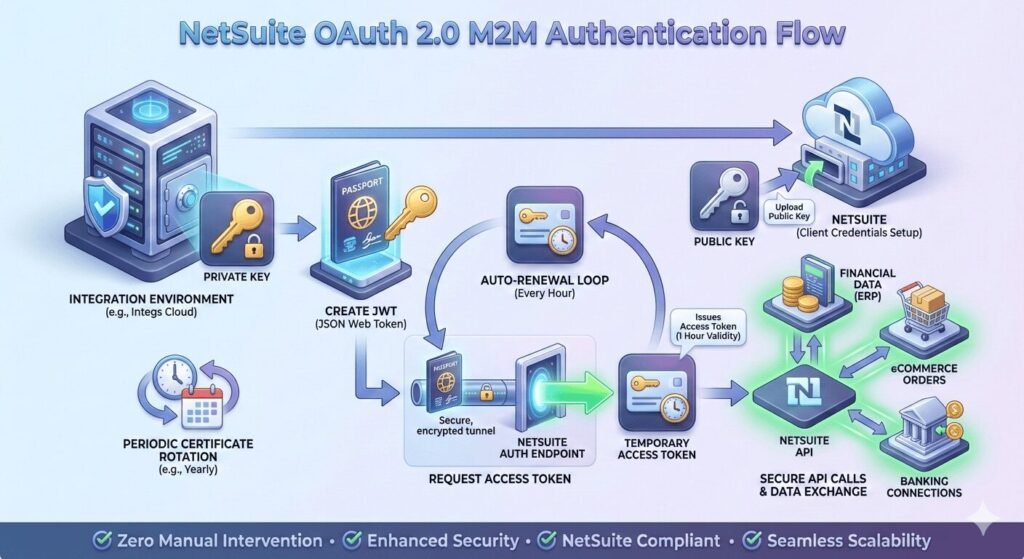
Here’s a simple breakdown of how the OAuth 2.0 M2M process works in a NetSuite integration setup:
- Generate a Certificate Key Pair
- A public and private key pair is created.
- The public key is uploaded in NetSuite under Client Credentials Setup.
- The private key stays securely within the integration environment.
- Create a JWT (JSON Web Token)
- A small digital “passport” called a JWT token is created.
- It includes details like the integration ID, permissions (scopes), and timestamps.
- This token is digitally signed using the private key.
- Request an Access Token from NetSuite
- The JWT token is sent to NetSuite’s secure authentication endpoint.
- In response, NetSuite issues an access token—a temporary key that grants access to APIs for one hour.
- Use the Access Token for Integration
- Once the access token is received, it’s used to make secure API calls—such as creating records, fetching data, or syncing transactions.
- Auto-Renew for Continuous Access
- Every hour, a new JWT and access token are automatically generated—ensuring uninterrupted and secure communication.
Built-in Renewal & Security Controls
Both the JWT token and the access token are time-bound, usually valid for one hour. This ensures that even if an access token is exposed accidentally, it becomes useless shortly after.
Additionally, the certificate keys used for signing JWTs are rotated periodically—typically every year or two—maintaining top-tier security standards.
Why Integs Cloud Adopts OAuth 2.0 M2M
At Integs Cloud, we believe that security and scalability go hand-in-hand. By implementing OAuth 2.0 M2M authentication, we achieve:
- Zero manual intervention – once configured, integrations run fully automated.
- Enhanced security – no passwords, just encrypted certificates.
- NetSuite compliance – aligned with Oracle NetSuite’s latest integration guidelines.
- Seamless scalability – multiple systems can authenticate independently using their own client credentials.
- Optimized performance – reduced token overhead and more efficient API communication.
The Bigger Picture
OAuth 2.0 Client Credentials Grant isn’t just a security upgrade—it’s a foundation for smarter, faster, and safer integrations.
By aligning with this modern authentication framework, Integs Cloud ensures that every integration—whether it’s financial data syncs, eCommerce orders, or banking connections—operates with enterprise-grade reliability and protection.
In Summary
- Generate JWT Bearer Token → Request OAuth Access Token → Use Access Token for API Calls
- Renew tokens automatically every hour
- Rotate certificates periodically for long-term security
With OAuth 2.0 Machine-to-Machine authentication, your NetSuite integrations stay secure, compliant, and always connected—just the way modern businesses need them.