Enterprise ERP debates often shrink Oracle NetSuite SuiteCloud down to a mere customization framework—the place developers go to spin up SuiteScripts, build workflows, or deploy custom records. That view is fundamentally outdated.
For an enterprise scaling across multiple entities, juggling dozens of SaaS integrations, and automating heavy operational workflows, SuiteCloud isn’t just a toolkit. It functions as an in-memory execution layer directly inside the ERP.
This isn’t semantic nitpicking; it’s a critical architectural distinction. The question is no longer, “Can we customize NetSuite?” Every modern SaaS ERP claims extensibility. The real question technical leaders must ask is:
Where should business execution actually live without compromising upgradeability, governance, or system performance?
SuiteCloud answers this by acting as a controlled execution boundary right where your data sits.
The Paradigm Shift: From Data Repository to Real-Time Execution
Historically, legacy ERP implementations treated the core system as a passive database—a glorified system of record. External apps handled the heavy automation, middleware did the orchestration, and internal developers slapped on custom scripts whenever a functional gap appeared.
Over time, this creates an architectural nightmare. Business logic gets scattered across:
- iPaaS platforms and middleware
- External microservices and webhooks
- Scheduled cron jobs and database procedures
- Ad-hoc ERP scripts
Eventually, no one on the engineering team can tell you exactly where a specific business rule executes.
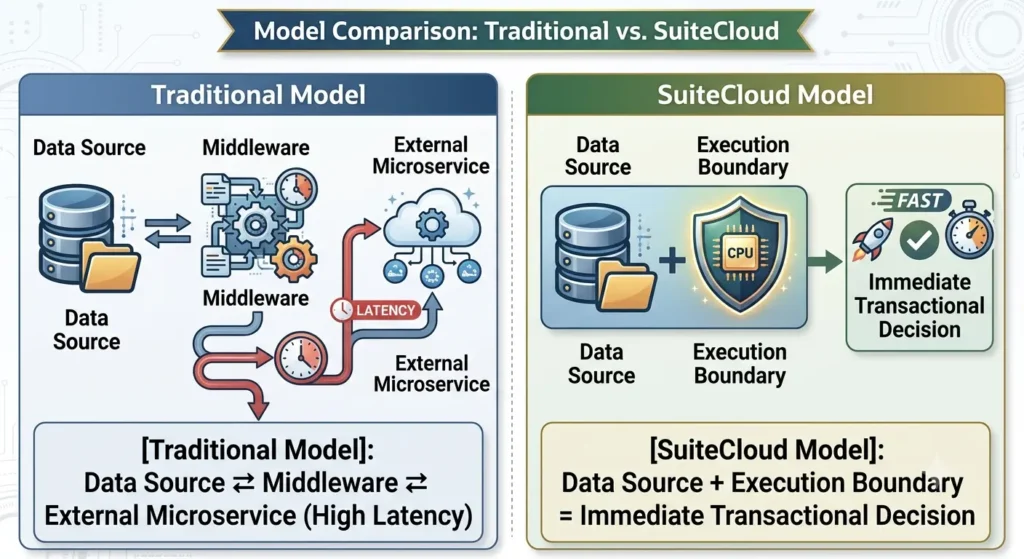
SuiteCloud flips this model. Instead of treating NetSuite as a dumb pipe for transactional data, it run heavily governed logic precisely where the transactions originate. We aren’t talking about basic CRUD operations here. We’re talking about core business mechanics:
- Dynamic revenue recognition validations
- Multi-subsidiary procurement approvals
- Complex matrix territory assignments
- Real-time order routing and inventory allocation
- Dynamic subscription lifecycle automation
By running this logic alongside the transaction, you stop data from constantly exiting and re-entering the ERP ecosystem just to make a decision.
Proximity to Data: Why Execution Location Trumps Flexibility
Many enterprise ERP projects fail not because they lacked customization options, but because the architects chose the wrong execution placement.
Consider a standard discount approval process. Look at the architectural overhead of trying to pull this outside the system versus keeping it native:
|
Metric / Aspect |
Option A: External Orchestration (ERP ⇆ Middleware ⇆ Approval Engine) |
Option B: Native SuiteCloud Execution |
|
Data Journey |
NetSuite $\rightarrow$ Middleware $\rightarrow$ External Engine $\rightarrow$ Back to NetSuite |
Stays entirely within the NetSuite framework |
|
API Overhead |
Heavy. Multiple round-trips required |
Zero external API calls |
|
Failure Modes |
Network timeouts, sync lag, inconsistent states |
Transaction aborts cleanly if validation fails |
|
Latency |
Variable (Seconds) |
Deterministic (Milliseconds) |
Option B doesn’t just eliminate API round-trips; it prevents data synchronization failures and dirty reads. The logic executes exactly where the context lives.
Domain-Centric ERP Architecture
Modern enterprise tech stacks favor domain-driven design. Instead of forcing every single business rule into a monolithic integration layer, organizations want logic to live inside the domain that owns it.
SuiteCloud allows these domains to operate independently while staying bound to the same underlying ERP governance framework:
- Finance Domain: Owns posting rules, tax engine logic, and journal validations via User Event scripts.
- Operations Domain: Controls fulfillment automation and warehouse routing.
- Sales Domain: Manages real-time pricing rules and complex commission matrices.
This decoupled execution model ensures that an update to your warehouse routing logic won’t accidentally break a financial close script.
Governance Limits are Guardrails, Not Bottlenecks
Developers new to Oracle NetSuite often complain about SuiteCloud’s governance constraints—usage units, timeout limits, and concurrency ceilings. But from an enterprise architecture perspective, governance is a core feature, not a bug.
Unbounded code running inside a multi-tenant ERP is dangerous. It blocks transaction threads, creates database deadlocks, stalls financial close windows, and causes unpredictable performance spikes. SuiteCloud’s strict limits force developers to write highly optimized, defensive code. It pushes engineering teams toward:
- Idempotent processing that can recover gracefully from interruptions.
- Asynchronous, queue-based workloads for heavy liftoffs.
- Modular, event-driven services rather than massive, monolithic scripts.
Matching the Business Requirement to the Right SuiteCloud Tool
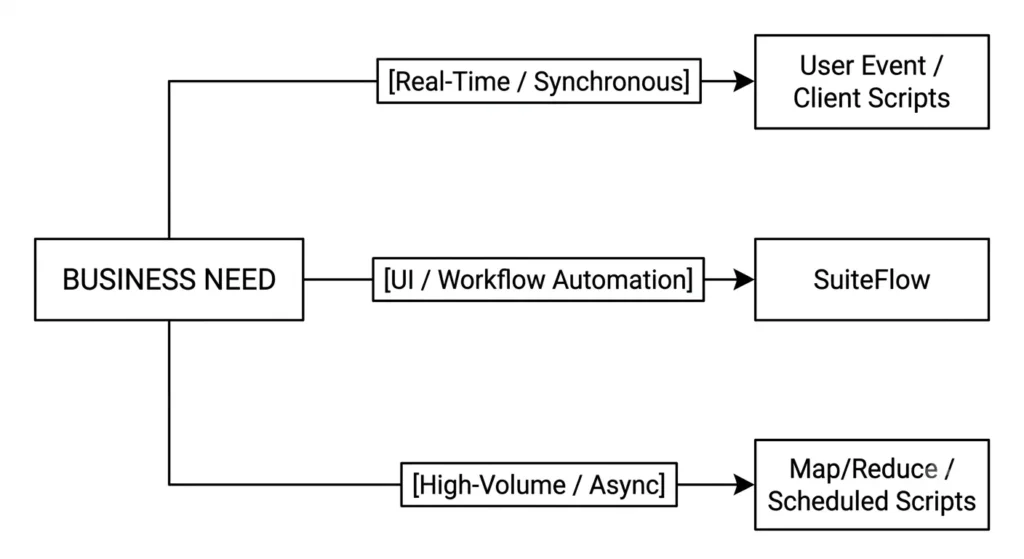
A common anti-pattern during NetSuite implementation services is treating SuiteScript like a hammer for every single nail. SuiteCloud offers a nuanced matrix of execution models. Choosing the wrong one introduces immediate technical debt.
-
User Event Scripts: Best for transactional validation and data mutation right before it hits the database.
-
Client Scripts: Reserved strictly for real-time UI guidance and field-level browser validation.
-
SuiteFlow (Workflows): Ideal for visual business approvals that business analysts need to audit or tweak without writing code.
-
Map/Reduce & Scheduled Scripts: Designed for high-volume, bulk data processing that can run asynchronously without blocking users.
-
RESTlets & SuiteTalk: Essential for exposing secure, high-performance endpoints to external systems.
The Clean Architecture Heuristic: When to Stay In vs. Move Out
Enterprise extensibility isn’t about writing code everywhere just because you can. It’s about knowing where code belongs. When working with an experienced NetSuite partner, use this simple heuristic to draw your execution boundaries:
Keep the logic inside NetSuite when:
- Strict transactional consistency is mandatory (e.g., if step B fails, step A must roll back).
- Deep ERP contextual data is required to make the decision.
- Users require immediate, synchronous feedback on the screen.
Push the logic outside (to AWS, Azure, OCI, etc.) when:
- The compute requirements are intensely heavy or require long-running CPU processing.
- Large-scale AI model processing or LLM calls are involved.
- The orchestration spans across multiple distinct external systems where NetSuite is just one of many players.
The Strategic View: Future-Proofing the Core
When technical leaders evaluate an ERP, they shouldn’t just look at a feature checklist. They need to look at execution predictability.
SuiteCloud ensures that your custom business logic remains isolated, modular, and—critically—upgrade-compatible. NetSuite handles the underlying infrastructure upgrades twice a year, while your bounded execution layer continues to run unaffected.
Ultimately, thinking of SuiteCloud as an execution layer shifts the paradigm. It stops being a discussion about customizing screens, and becomes a strategic decision on how to centralize enterprise logic without fracturing your architecture across a dozen disconnected systems.
Architecting SuiteCloud as an execution layer requires careful planning around customization boundaries, governance, and integrations. Working with an experienced NetSuite partner like Integs Cloud can help ensure your implementation remains scalable, upgrade-compatible, and aligned with long-term business goals.