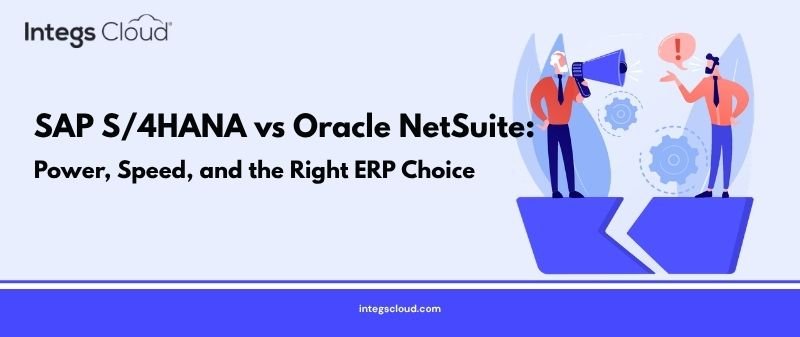
SAP S/4HANA vs Oracle NetSuite (2026): Complete ERP Comparison, Pricing, Features, and Best Choice
Choosing the right ERP system is a strategic decision that directly impacts your company’s operations, financial visibility, and long-term scalability.
An ERP is not just software—it becomes the backbone of how your business runs. The wrong choice leads to inefficiencies and ongoing costs. The right choice drives compounding growth and operational clarity.
This guide provides a comprehensive, decision-focused comparison of SAP S/4HANA vs Oracle NetSuite based on real-world implementation, cost structure, system architecture, and business impact.
Quick Comparison: SAP S/4HANA vs Oracle NetSuite
|
Feature |
SAP S/4HANA Public Cloud |
Oracle NetSuite |
|
Best For |
Large enterprises |
Mid-sized and scaling companies |
|
Architecture |
Multi-product ecosystem |
Unified platform |
|
Deployment |
Public + Private Cloud |
Multi-tenant SaaS |
|
CRM |
Separate (Sales Cloud) |
Built-in |
|
Analytics |
External tools required |
Native dashboards |
|
Implementation Time |
Long |
Fast |
|
Customization |
ABAP + BTP |
SuiteScript, SuiteFlow |
|
Cost |
High upfront |
Subscription-based |
|
Time to Value |
Slow |
Fast |
SAP vs NetSuite Cost and TCO Comparison
One of the most critical decision factors for ERP selection is the total cost of ownership (TCO) over time—not just the initial investment.
The table below highlights a realistic comparison based on typical implementations in India:
|
Factor |
SAP S/4HANA |
Oracle NetSuite |
|
Upfront License Cost |
Very high (crores) |
Low (subscription-based) |
|
IT Infrastructure |
High (servers, IT team required) |
None (fully cloud-based) |
|
Implementation Time |
12–24 months |
3–6 months |
|
Upgrade Cost |
High (project-based upgrades) |
Included (automatic updates) |
|
Annual Maintenance |
~20% of license cost |
Included in subscription |
|
Scalability Cost |
High and expensive to scale |
High but cost-efficient |
|
5-Year TCO |
Highest |
30–40% lower than SAP |
Key Takeaway
SAP S/4HANA typically involves significant upfront investment and ongoing costs due to infrastructure, upgrades, and multiple system dependencies.
Oracle NetSuite, on the other hand, operates on a subscription-based model with built-in upgrades and minimal infrastructure requirements, making it more cost-efficient over a 5-year period for most mid-sized businesses.
What is the Difference Between SAP S/4HANA and Oracle NetSuite?
SAP S/4HANA is designed for large enterprises that require deep financial control and regulatory compliance, while Oracle NetSuite is built for mid-sized and growing businesses that need faster implementation and a unified system.
What is SAP S/4HANA Public Cloud?
SAP S/4HANA is an enterprise ERP system designed for organizations with complex operational and regulatory requirements.
Key capabilities:
- Advanced financial governance and compliance (IFRS, GAAP)
- Strong auditability and reporting controls
- Support for large-scale, global operations
Core approach:
SAP follows a fit-to-standard model, where businesses adapt processes to SAP’s predefined structure. This improves consistency but reduces flexibility.
SAP is best suited for organizations that prioritize control, compliance, and standardized processes over speed.
What is Oracle NetSuite?
Oracle NetSuite is a cloud-native ERP built as a unified business suite.
Core modules include:
- Financial management
- CRM
- Inventory and supply chain
- Order and revenue management
Key advantages:
- Built for the cloud from the beginning
- Single data model across all functions
- Faster implementation and easier scalability
NetSuite is designed for companies that want operational efficiency without managing multiple systems.
SAP vs NetSuite: Detailed Comparison
1. Implementation Speed and Time to Value
SAP S/4HANA
- Longer implementation cycles due to complexity
- Requires experienced consultants and system integrators
- Higher training requirements for users
NetSuite
- Faster deployment using pre-configured workflows
- Easier adoption by business users
- Lower dependency on IT teams
Conclusion: NetSuite delivers faster time to value and lower implementation risk.
2. System Architecture: Multi-System vs Unified Platform
SAP Architecture
A typical SAP environment includes multiple systems:
- Core ERP (S/4HANA)
- Procurement (Ariba)
- Expense management (Concur)
- Planning (IBP)
- Analytics (SAP Analytics Cloud)
Each component requires integration, increasing complexity and cost.
NetSuite Architecture
- ERP, CRM, analytics, and planning in one system
- Single database and unified data model
- No heavy integration requirements
Conclusion: NetSuite significantly reduces system complexity and integration overhead.
3. Financial Management and Multi-Entity Operations
SAP
- Strong compliance with global standards
- Advanced financial controls
- Multi-entity consolidation may require additional tools
NetSuite
Oracle NetSuite OneWorld capabilities include:
- Multi-entity consolidation
- Multi-currency management
- Real-time reporting
Conclusion: SAP is stronger for deep compliance. NetSuite is more efficient for multi-entity management.
4. Reporting and Analytics
SAP
- Requires external tools such as SAP Analytics Cloud
- Data often distributed across systems
NetSuite
- Built-in dashboards and reporting
- Real-time financial and operational visibility
Conclusion: NetSuite provides more accessible and real-time analytics without additional tools.
5. CRM and Customer Lifecycle Management
SAP
- CRM is not included in the core ERP
- Requires integration with SAP Sales Cloud
NetSuite
- CRM is built into the platform
- Covers lead management, sales, and order tracking
Conclusion: NetSuite provides a unified customer lifecycle without integration dependency.
6. Customization and Flexibility
SAP
- Customization through ABAP and SAP BTP
- Resource-intensive and complex
NetSuite
- SuiteFlow for workflows
- SuiteScript for scripting
- SuiteBuilder for UI customization
Conclusion: NetSuite enables faster, more cost-effective customization.
7. Manufacturing and Supply Chain Capabilities
SAP
- Strong in large-scale and complex manufacturing
- Public Cloud has limitations in advanced manufacturing scenarios
NetSuite
NetSuite has strong support for:
- Mixed-mode manufacturing
- Engineer-to-order
- Multi-location operations
Conclusion: SAP is suited for highly complex enterprises, while NetSuite is more practical for mid-market manufacturing.
8. Cost Comparison (India Perspective)
SAP S/4HANA
- High initial investment
- Additional licensing for multiple products
- Higher implementation and consulting costs
NetSuite
- Subscription-based pricing
- Lower upfront investment
- Flexible scaling based on modules
Conclusion: NetSuite is generally more cost-effective for mid-sized businesses in India.
SAP vs NetSuite: Pros and Cons
SAP S/4HANA
Advantages
- Strong financial governance
- Enterprise-grade capabilities
- Industry-specific functionality
Limitations
- High total cost of ownership
- Complex implementation
- Multiple add-ons required
Oracle NetSuite
Advantages
- Unified platform across functions
- Faster implementation and ROI
- Lower IT and consulting dependency
- Scalable for growing businesses
Limitations
- Less suitable for extremely large enterprises
- Costs increase with additional modules
- Limited deep customization compared to SAP
SAP vs NetSuite Comparison Summary
|
Use Case |
Best Choice |
|
Large enterprise ERP |
SAP S/4HANA |
|
Mid-sized business ERP |
Oracle NetSuite |
|
Fast implementation |
Oracle NetSuite |
|
Complex compliance |
SAP S/4HANA |
|
Lower cost ERP |
Oracle NetSuite |
|
Unified system |
Oracle NetSuite |
SAP vs NetSuite: Which One Should You Choose?
Choose SAP S/4HANA if:
- You operate in a highly regulated industry
- You require deep financial control and governance
- Your organization has complex global operations
Choose Oracle NetSuite if:
- You are a mid-sized or growing business
- You need fast implementation and quicker ROI
- You want to avoid managing multiple systems
- You prefer simplicity and operational efficiency
Key Decision Factors
Before selecting an ERP, evaluate:
- Operational complexity
- Internal IT capabilities
- Implementation timeline expectations
- Budget constraints
- Long-term scalability requirements
The right ERP is not the most powerful system—it is the one your organization can successfully implement and sustain.
Frequently Asked Questions
Is SAP better than NetSuite?
SAP is better suited for large enterprises with complex requirements. NetSuite is better for mid-sized businesses that prioritize speed and simplicity.
Why do companies choose NetSuite over SAP?
Companies choose NetSuite for faster deployment, lower cost, and a unified system that reduces dependency on multiple tools.
Is NetSuite cheaper than SAP?
In most cases, yes. NetSuite has a lower upfront cost and a more flexible pricing model.
Can NetSuite support large organizations?
Yes, but extremely complex enterprises may still prefer SAP.
Does SAP include CRM functionality?
No. SAP requires a separate CRM solution, while NetSuite includes CRM within the platform.
Final Verdict: SAP vs NetSuite (2026)
The decision comes down to a fundamental trade-off:
- SAP S/4HANA offers depth, control, and enterprise-grade capability at the cost of complexity
- Oracle NetSuite offers speed, simplicity, and faster ROI with lower operational overhead
For most growing businesses, speed of execution and ease of use deliver better long-term outcomes than system complexity.
Oracle NetSuite Implementation in India
Choosing the right implementation partner is critical to ERP success.
Integs Cloud provides:
- NetSuite implementation and deployment
- Workflow customization and scripting
- Integration with platforms like Shopify and Zoho
- Ongoing optimization and support
A well-executed NetSuite implementation can significantly improve operational efficiency, financial visibility, and decision-making speed.
Conclusion
Selecting between SAP and NetSuite is not about choosing the most feature-rich system.
It is about choosing:
- A system your team can adopt
- A system you can manage effectively
- A system that delivers measurable ROI
For most mid-sized and scaling businesses in 2026, NetSuite provides a more practical and efficient path to growth, while SAP remains the preferred choice for highly complex enterprise environments.
Contact Integs Cloud
Integs Cloud ensures that your NetSuite implementation is smooth, structured, and results-driven. Whether you’re migrating from legacy systems or expanding operations, our team helps you achieve operational efficiency, real-time financial visibility, and faster ROI.